Categories
Agricultural Research Institute: RTK+UWB Integrated Navigation Following Transport Vehicle
This is an unmanned tracked transport vehicle designed to collaborate with agricultural workers, enhancing picking efficiency by assisting with transportation tasks.
Project Summary:
A certain agricultural research institute plans to deploy autonomous harvesting robots in its approximately 1,000-square-meter orchard. The robots are required to possess strong load-bearing capacity and extended battery life to operate reliably in outdoor farm conditions, including the ability to traverse obstacles such as field ridges. The core function of the robot is to assist staff during fruit picking operations. Once the fruit load reaches full capacity, the robot will automatically return along a predefined path to a designated unloading station. Throughout the operation, it is essential to ensure the safety of surrounding personnel by maintaining a safe distance from obstacles and workers at all times.
Project Requirements:1、Load capacity of at least 200 kg.2、The robot must be able to follow farm workers while maintaining a safe distance.3、The robot should possess off-road capability, enabling operation on sandy soil and in trenches.4、When no personnel are detected nearby, the robot must transport crops autonomously to predefined locations using satellite navigation.5、Single-cycle operational endurance of no less than 5 hours6、A certain degree of water resistance is required.
Project Solutions:This project can be implemented based on our company’s GT-01 series tracked mobile robot chassis, which offers the following advantages: (1)Capable of carrying loads exceeding 300 kg while maintaining stable operation.(2) Equipped with a suspended vibration-damping tracked chassis and dual-motor differential drive powered by high-torque motors, providing strong obstacle-crossing capability. It also features zero-radius turning, making it suitable for narrow outdoor environments.(3) Rated IP54 for water and dust resistance, ensuring reliable operation even in rainy conditions.
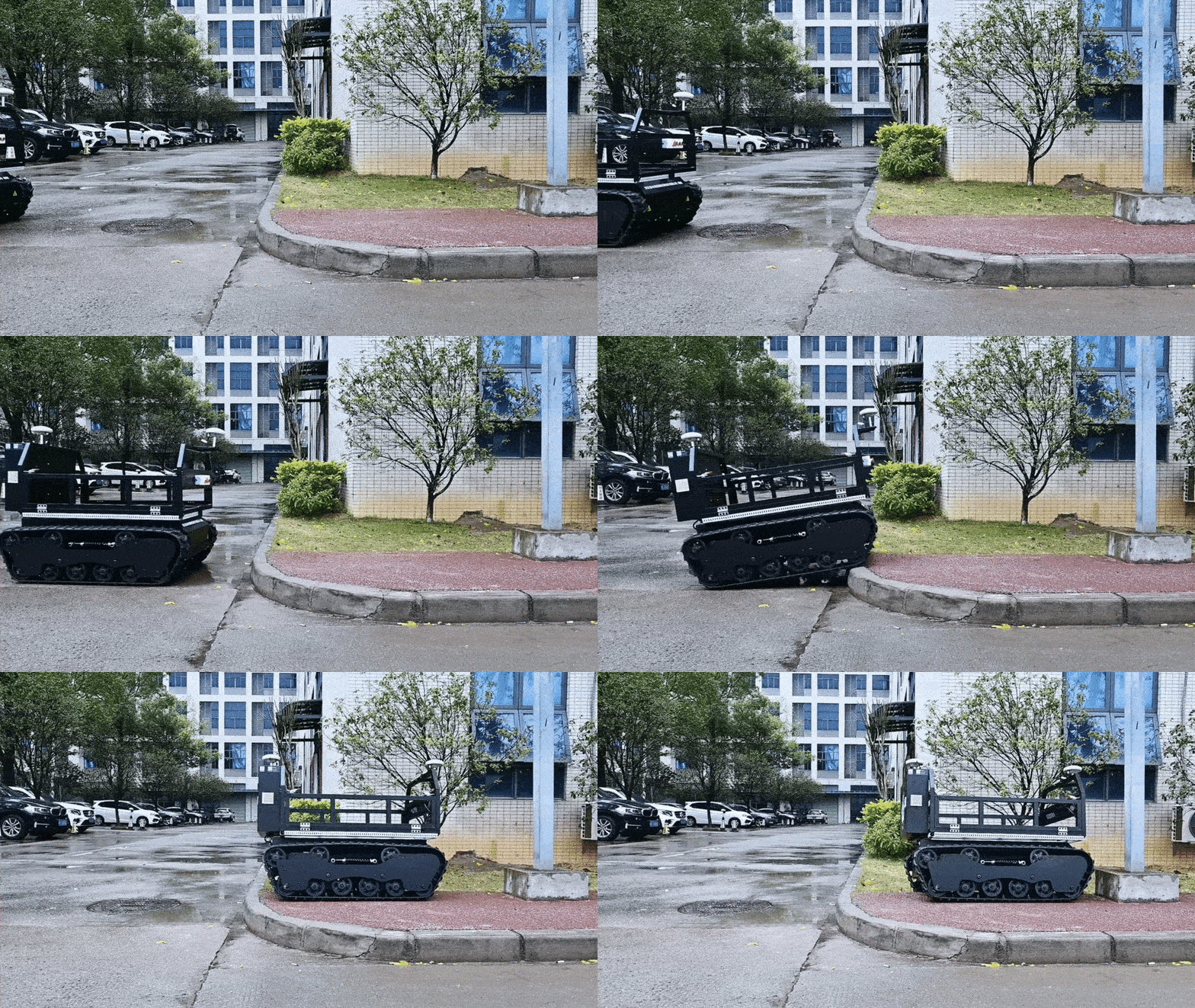 For the following function, the system uses a UWB base station combined with handheld tags, wristbands, or a remote control to enable real-time intelligent tracking. In follow-mode, when a worker carries a tag, the robot follows the individual’s movement while continuously adjusting to maintain a preset safety interval.In terms of navigation, the robot supports automated return functionality. Our proprietary RTK integrated navigation system uses satellite signals to achieve high-precision positioning and navigation. Operators can also trigger the return command via the robot’s control interface once unloading is complete.For safety, the vehicle is equipped with ultrasonic radar sensors (at least 8 units) around the chassis to monitor the environment and avoid collisions. An emergency stop button is also integrated into the control panel for immediate operation interruption when needed.
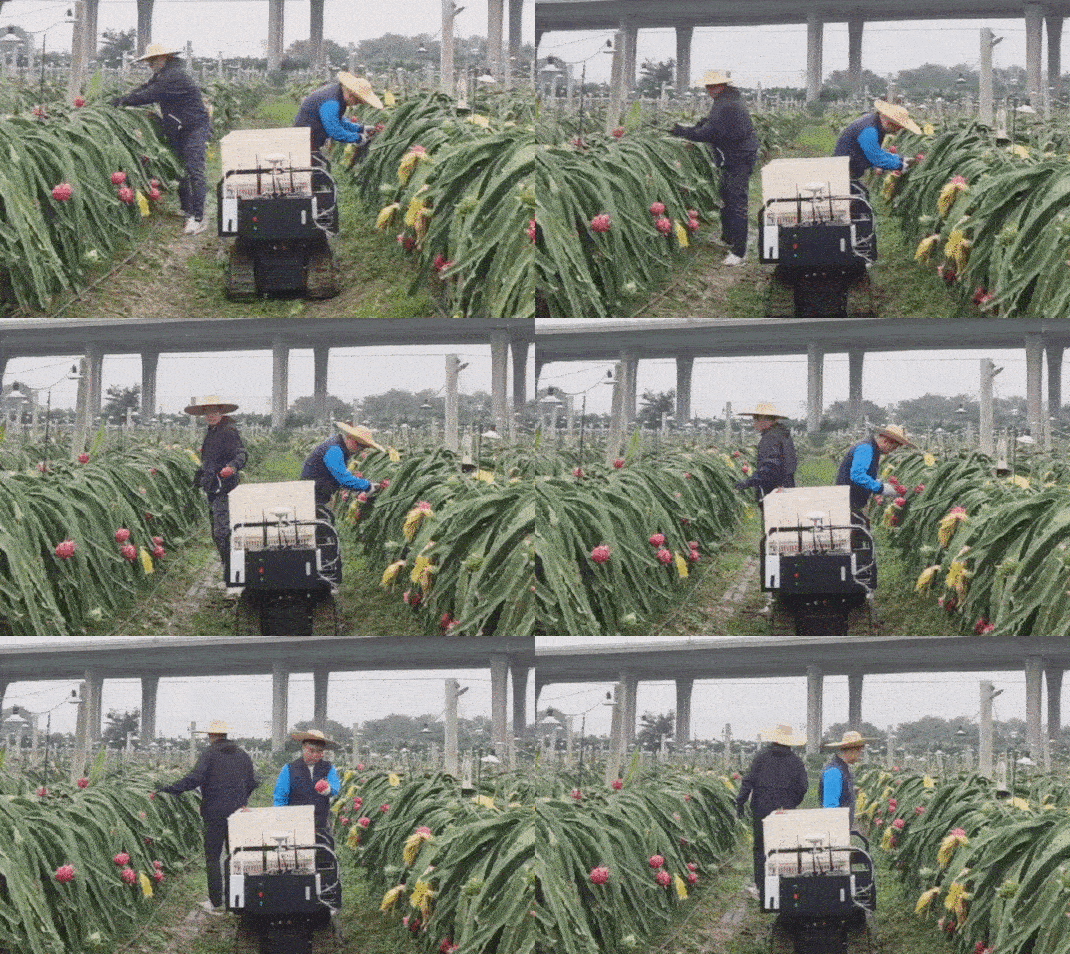 Project Outcomes and Summary:This project successfully developed an unmanned follow-up transportation system based on RTK and UWB fusion navigation, effectively improving the automation level and human-machine collaboration efficiency of orchard harvesting operations. The robot not only has a load capacity of over 200 kilograms and a continuous operation time of 5 hours, but also adapts to complex farmland environments such as sandy soil and furrows. It has also achieved important functions such as autonomous transportation in accordance with regulations and automatic return and unloading when fully loaded, all without human supervision. Through UWB precise following and multi-sensor safety obstacle avoidance mechanisms, both personnel safety is ensured and labor intensity is significantly reduced, while shortening the harvesting cycle. The entire system has excellent environmental adaptability (IP54 protection rating), providing stable, reliable, and intelligent transportation support for modern agricultural research scenarios, and laying a solid foundation for future large-scale applications.

